Shieldora documentation
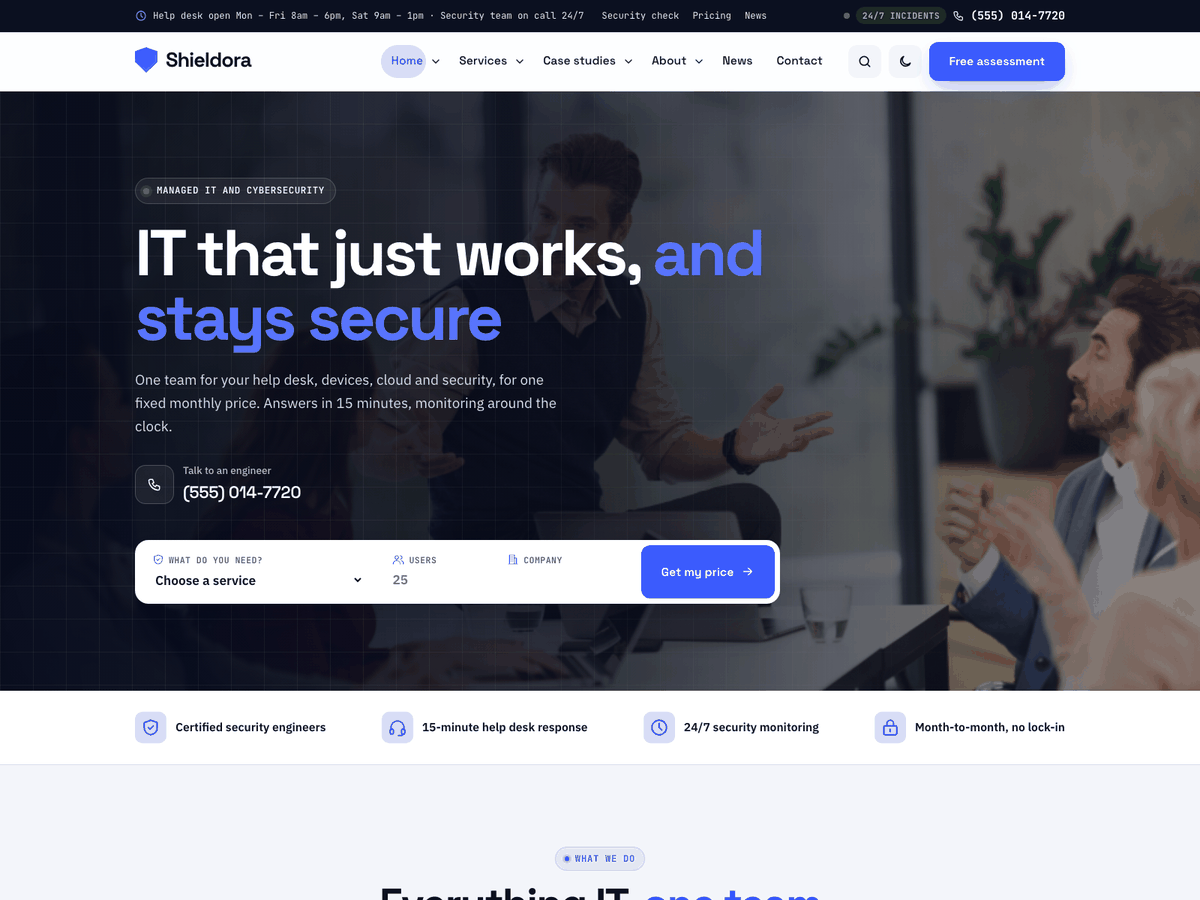
A WordPress theme for IT companies: managed service providers, cybersecurity firms, cloud consultants, small business IT support, network installers and compliance specialists. Six demos, a quote bar, services priced per user, a security self-check with a live score, filterable case studies, industries, engineer profiles, free IT assessment requests with a live guide price and a monthly IT cost estimator.
Thank you for choosing Shieldora. This guide takes you from a fresh WordPress site to a copy of the demo with your own details. If something is not covered here, write to support@codememory.com — we answer within one working day.
- Version1.0.0
- WordPress6.5 or later
- PHP7.4 or later
- Live demoOpen the demo
Highlights
- Six IT and cybersecurity demos imported in one click
- Quote bar in the hero: service, number of users and company, sent to your assessment page
- Security self-check: visitors tick what they have and see a score ring and the gaps to fix
- Services priced per user a month (or per device, hour or project), with response time, support hours and onboarding time
- Case studies with industry filters, client, headline result, duration and a project timeline
- Industry tiles with a photo and the number of case studies
- Free IT assessment form with company, users, start date, budget and a live monthly guide price, saved in your dashboard
- Monthly IT cost estimator with a volume discount for larger teams
- Engineer profiles with role, certifications, years with you and specialty
- Solutions and industries to group services and case studies
- Help desk hours with an "Open now" badge
- 20 Elementor widgets (free Elementor)
- Every section also works as a shortcode
- Call / assessment bar on phones
- Light and dark mode
- Colours and fonts from the Customizer
- Block patterns and every core block styled
- Self-hosted fonts, nothing loaded from Google
- Translation ready, right-to-left support
- Child theme included
What is in the download
themeforest-shieldora-wordpress-theme/
├── shieldora.zip               ← the theme: upload this in WordPress
├── shieldora-child.zip         ← child theme, for your own code changes (optional)
├── plugins/shieldora-core.zip  ← the theme's plugin (also installed from inside the theme)
├── demo-content/               ← demo files for a manual import
├── documentation/              ← this guide, as HTML and PDF
└── licensing/                  ← GPL licence, font licences and credits
shieldora.zip, not the whole download. Uploading the download zip gives the error
"The package could not be installed. The theme is missing the style.css stylesheet."Requirements
- WordPress 6.5 or later (tested up to 7.1).
- PHP 7.4 or later (8.2 or later recommended).
- For the demo import: PHP
memory_limit256M,max_execution_time300, upload size 32M. Most hosts already allow this; if an import stops half-way, ask your host to raise these values.
Every plugin the theme uses is free from wordpress.org. Nothing needs a paid licence.
Installing the theme
- In your dashboard, go to Appearance → Themes → Add New Theme → Upload Theme.
- Choose
shieldora.zipand click Install Now, then Activate. - Optional: install and activate
shieldora-child.zipthe same way (see Child theme).
Upload by FTP instead: unzip shieldora.zip and copy the shieldora folder to
wp-content/themes/, then activate it under Appearance → Themes.
Plugins
After activation, a notice at the top of the dashboard lists the plugins the theme uses. Click Begin installing plugins (or go to Appearance → Install Plugins), select them all, choose Install, then activate them.
| Plugin | What it adds | |
|---|---|---|
| Shieldora Core | Required | Services, case studies, team, solutions, industries, reviews, assessment form, security self-check, help desk hours, IT cost estimator, widgets, shortcodes and the demo import. Included with the theme. |
| Elementor | Recommended | The free page builder used for the demo pages. The theme's own widgets appear in Elementor's Shieldora group. |
| One Click Demo Import | Recommended | Imports a demo in one click. You can remove it after the import. |
The theme works without any plugin: posts, pages, menus, widgets and search are styled the same. The plugin is needed for the IT features (services, case studies, team, assessment form, security check…).
Importing a demo
The import gives you the demo site: pages, services, case studies, team members, reviews, posts, menus, widgets and the Customizer settings. Use it on a new site: it adds content next to what you already have.
- Install the plugins above.
- Go to Appearance → Import Demo Data.
- Pick a demo and click Import. It takes one to three minutes; keep the page open.
- Done: visit your site. The home page, menus and blog page are already set.
| Demo | Home page | Accent |
|---|---|---|
| Managed IT services | /home-managed/ | #3b5bfd |
| Cybersecurity firm | /home-security/ | #16a34a |
| Cloud & DevOps | /home-cloud/ | #0284c7 |
| Small business IT support | /home-helpdesk/ | #ea580c |
| Network & infrastructure | /home-network/ | #7c3aed |
| Data protection & compliance | /home-compliance/ | #0f766e |
All six home pages are imported with every demo; the demo you pick decides which one is the front page and which colours and header the Customizer uses. To switch later, go to Settings → Reading and choose another home page.
Manual import
If the one-click import is blocked by your host, use the files in demo-content/:
- Tools → Import → WordPress (install the importer when asked) → upload
content.xml. - Install Widget Importer & Exporter → Tools → Widget Importer & Exporter → upload
widgets.wie. - Install Customizer Export/Import → Appearance → Customize → Export/Import → upload
customizer-<demo>.dat. - Appearance → Menus → Manage Locations: set the main, top bar and footer menus. Settings → Reading: choose the home and blog pages.
After the import: your details
The demo uses a made-up phone number, address, help desk hours and prices. Replace them with yours, in this order:
- Phone number and top bar: Appearance → Customize → Shieldora options → Header and top bar. Set Phone number, Top bar text (a short line such as your help desk hours) and the Label next to the phone (the demo says "24/7 incidents"). Every "Call" button on the site uses this number.
- Logo and site icon: Appearance → Customize → Site Identity.
- Colours: Appearance → Customize → Colors. The six demo home pages each have their own accent colour (see Page options); clear it there to use the Customizer colour.
- Assessment page, help desk hours, estimator prices and request emails: Settings → Shieldora Core (see Assessment requests, Help desk hours and IT cost estimator).
- Footer widgets: Appearance → Widgets → Footer column 1–4: edit the Contact details widget (address, phone, email).
- Your content: edit the services, case studies, team and reviews in the dashboard menus Services, Projects, Team and Reviews, and replace the grey placeholder photos with your own.
Services, case studies, team and reviews
The Shieldora Core plugin adds four content types, a Solutions list and an Industries list to the dashboard. Each content type has a Details box under the editor.
| Menu | Used for | Details |
|---|---|---|
Services/services/ | One page per service you sell. Shown by the Services widget and the services archive, and listed in the assessment form and the quote bar. | Icon, price from ("$95"), price note ("per user a month, every device included"), how the price works (per user a month, or per device, hour or project), onboarding time, response time, support hours, what is included (one per line) and an "At a glance" list (one line per item as label|value, for example Contract|Monthly, cancel anytime). |
Projects/projects/ | Your case studies. Shown by the Projects widget as cards, newest first. | Completed on (a date), duration ("6 weeks"), service ("Cloud migration"), headline result ("Zero downtime"), client ("Law firm, 45 users") and a timeline (one line per stage as when|what, for example Week 1|Audit and backup of every device). |
Team/team/ | The engineers clients talk to. | Role, years with you, certifications, specialty, where they are based and an optional email. The featured image is the portrait (a tall photo works best). |
| Reviews | Client reviews shown by the Reviews widget (no page of their own). | Rating, reviewer ("Practice manager, Riverside Clinic"), project or service, where the review was left. The title is the reviewer's name; the text is the review. |
Industries (under Projects) group case studies by client type, for example Healthcare or
Legal. Each industry has its own page at /industry/<name>/, and the Industries widget shows each one as a
photo tile with its number of case studies (the photo comes from the newest case study in that industry).
Solutions (under Projects) group services and case studies by the kind of work, for example Cloud or
Security, with a page at /solution/<name>/. A case study can have several of each; the Projects widget can show one
industry or one solution only.
Turn on Show filter buttons by industry in the Projects widget (or filter="yes" in the shortcode) to add a
button per industry above the cards; visitors click one to see only those case studies.
The featured image of a service, case study or post is used on its card and at the top of its page. Use landscape photos at least 1600 × 900 px.
Assessment requests
The Assessment form widget (or the [shieldora_quote] shortcode) asks for the client's
name, phone and email, the service, the company name, the number of users, when they want to start, a budget range, how to
reply (email, phone call or video call) and an optional message. Name and a phone number or email are required. Spam
protection is built in (a hidden field and a limit on repeated sends) and no other plugin is needed.
- When the client picks a service priced per user and types the number of users, the form shows a monthly guide price as they type (price × users). Services priced per device, hour or project show no guide price. The saved request gets its own estimate, worked out from the service price on the server.
- Every request is saved under Requests in the dashboard, with a counter of new ones. Open a request to see the details and set its status: New, Contacted, Assessment booked, Proposal sent, New client, Closed.
- The services in the form come from your Services, so they stay up to date.
- Settings → Shieldora Core → Assessment requests: choose the Assessment page (the page with the Assessment form widget), turn email alerts on or off, choose the address (empty = the site admin email), list your Budget ranges (one per line; leave empty to hide the budget field), and edit the thank-you message and the privacy note under the form.
- Emails are sent by WordPress. If they do not arrive, install an SMTP plugin such as WP Mail SMTP; requests are saved in the dashboard either way.
The quote bar
Turn on Show the quote bar in the Hero widget. Visitors pick a service, type the number of users and their company and press Get my price: the assessment page opens with the form already filled in. The button on each service page opens the same form with that service chosen.
Price per seat or device instead of per user: set Pricing unit under IT cost estimator; the quote bar, the form and the estimator all use it.
Security self-check
The Security check widget (or the [shieldora_check] shortcode) lists simple yes/no
protections, such as multi-factor sign-in or tested backups. Visitors tick the ones they already have, and the panel beside
the list updates as they go:
- a score ring with the share of protections in place (red under 50%, amber from 50%, green from 80%);
- a verdict line for each level;
- a Fix these first list with the advice for every box that is not ticked;
- an optional button to your assessment page (leave its link empty to use the Assessment page from Settings).
Edit the questions in the widget's Checks field, one per line as question|advice when missing, for
example Multi-factor sign-in on email|Turn on multi-factor sign-in for email first. Leave the advice out to repeat
the question in the list. Everything runs in the visitor's browser: answers are never sent or stored.
Help desk hours
Settings → Shieldora Core → Help desk hours: set an opening and a closing time for each day. Leave both empty on days you are closed, and add an optional note (for example "Monitoring and emergency response run 24/7").
- The Help desk hours widget (Elementor) or
[shieldora_hours]shortcode shows the hours beside your address and phone number. The Shieldora: Help desk hours widget shows them in the sidebar or footer. - Today's row is highlighted, and a badge says Open now (with the closing time) or Closed now. The badge uses the time zone in Settings → General, and it is worked out in the visitor's browser, so it stays right even when your pages are cached.
- The week starts on the day set in Settings → General → Week Starts On; times use the time format set there.
IT cost estimator
Settings → Shieldora Core → IT cost estimator: list your plans, one per line as
Plan|price per user a month|smallest monthly fee, for example Managed IT|95|950. Set the
currency symbol, the pricing unit (user, device or seat), the volume discount and the team size that gets it, and the note
under the result.
The IT cost estimator widget (or [shieldora_calculator]) lets a visitor pick a
plan and type the number of users. It shows the monthly total and the price per user ("About $5,130 a month, or $86 per user"),
never less than the smallest monthly fee, worked out in the browser: nothing is sent or stored. Turn on List the plans and prices
in the widget to show every plan with its price beside the estimator.
Page options
Each page has a Page options box in the editor sidebar:
- Accent colour for this page: overrides the Customizer accent on this page only. The demo uses it to give each demo home page its own colour.
- Colour scheme: light or dark for this page only (the Cybersecurity firm demo is dark).
- Header layout: classic, centered or contact, for this page only.
Leave them empty to follow the Customizer.
Page templates
| Template | Use |
|---|---|
| Default | Page title band, content and no sidebar. |
| Full width, no title | For pages built with Elementor: the content fills the screen and you add your own hero. All demo pages use it. |
| Full width with title band | The title band, then full-width content. |
Customizer settings
Appearance → Customize. Colours are in the Colors section; everything else is in the Shieldora options panel. Changes show in the preview before you publish them.
| Setting | Type | Default |
|---|---|---|
| Colors | ||
| Accent colour (buttons, links, icons) | color | #3b5bfd |
| Ink colour (text, header, footer) | color | #0b1020 |
| Paper colour (page background) | color | #f3f5fa |
| Style and fonts | ||
| Colour scheme | select | Light |
| Show a light/dark switch in the header | checkbox | On |
| Heading font | select | Space Grotesk |
| Body font | select | IBM Plex Sans |
| Body text size (px) | number | 17 |
| Corner rounding (px) | number | 12 |
| Header and top bar | ||
| Header layout | select | Classic: logo left, menu right |
| Keep the header visible while scrolling | checkbox | On |
| Show the search button | checkbox | On |
| Header button text | text | empty |
| Header button link | url | empty |
| Show the top bar | checkbox | On |
| Top bar text (for example your help desk hours) | text | empty |
| Phone number | text | empty |
| Label next to the phone (for example "24/7 incidents") | text | empty |
| Footer | ||
| Widget columns | select | 4 |
| Footer text (links allowed). Leave empty for the site name and year. | textarea | empty |
| Show a back-to-top button | checkbox | On |
| Blog | ||
| Post list layout | select | Grid of cards |
| Sidebar | select | Right |
| Show the author on posts | checkbox | On |
| Show the date on posts | checkbox | On |
| Show related posts under each post | checkbox | On |
| Mobile call bar | ||
| Show a call / assessment bar at the bottom of phone screens | checkbox | On |
| Second button text (the first button calls your phone number) | text | empty |
| Second button link | url | empty |
The site title, tagline, logo, site icon, background and homepage settings are WordPress's own, in Site Identity, Background image and Homepage Settings.
Widgets
Appearance → Widgets. Areas: Blog sidebar and Footer column 1 to Footer column 4 (set the number of footer columns in the Customizer). The plugin adds three widgets, named Shieldora: … in the widget list:
- Contact details — phone, email, address, each with a link.
- Help desk hours — your hours from Settings → Shieldora Core, with an "Open now" badge.
- Services list — links to your services; the current service is highlighted.
Building pages with Elementor
All demo pages are built with the free Elementor plugin and the theme's widgets.
- Create a page, set its Template to Full width, no title, and click Edit with Elementor.
- Search for the widget or open the Shieldora group in the left panel and drag a widget onto the page.
- Edit its text and options in the left panel. Every widget has a Background option (light, paper, dark or accent colour) so sections alternate like the demo.
The widgets fill themselves from your content: Services, Industries, Case studies, Team, Reviews
and Latest posts show the items you add in the dashboard. List fields (prices, steps,
questions…) take one item per line, with the parts separated by |, as the help text under each field shows.
Elementor's own Google Fonts loading is switched off by the demo import, so the site keeps using the theme's self-hosted fonts.
Without Elementor: shortcodes
Every widget is also a shortcode, so you can build the same sections in the block editor: add a Shortcode block and type, for example:
[shieldora_projects count="6" columns="3" filter="yes"]
[shieldora_services count="6"]
[shieldora_check title="How exposed is your business?"]
[shieldora_quote title="Book a free IT assessment"]
Options are the same as in Elementor. In list options, separate items with || and parts with
|. Images take an attachment ID (Media → Library → the number in the address) or a full URL.
Hero — [shieldora_hero]
| Option | What it does |
|---|---|
layout | Layout Choices: split, cover |
primary_label | Button text |
primary_url | Button link |
show_phone | Show the phone number (from the Customizer) |
secondary_label | Second button text (when the phone is hidden) |
secondary_url | Second button link |
badges | Trust points, one per line |
finder | Show the quote bar (service, users and company) |
image | Photo |
rating | Rating (for example 4.9/5) |
rating_text | Rating note (for example "from 140 client reviews") |
card_title | Floating card title |
card_text | Floating card text |
Also: eyebrow, title, text.
Services — [shieldora_services]
| Option | What it does |
|---|---|
count | How many |
industry | Only this industry (slug, optional) |
scope | Only this solution (slug, optional) |
style | Style Choices: cards, icons |
show_price | Show prices |
more_label | Button under the grid |
more_url | Button link |
Also: eyebrow, title, text, columns, tone.
Industries — [shieldora_industries]
| Option | What it does |
|---|---|
count | How many industries (4 fills the row best) |
Also: eyebrow, title, text, tone.
Reviews — [shieldora_reviews]
| Option | What it does |
|---|---|
summary | Summary line (for example "4.9 average from 140 reviews") |
count | How many |
Also: eyebrow, title, text, columns, tone.
Team — [shieldora_team]
| Option | What it does |
|---|---|
count | How many |
Also: eyebrow, title, text, columns, tone.
Numbers — [shieldora_stats]
| Option | What it does |
|---|---|
items | Numbers as Value|Label, one per line |
Also: tone.
Why choose us — [shieldora_features]
| Option | What it does |
|---|---|
items | Features as icon|Title|Text, one per line. Icons: shield, lock, key, cloud, server, wifi, network, laptop, monitor, mobile, cpu, database, backup, bug, eye, fingerprint, headset, code, terminal, settings, trend, file, building, factory, scale, school, home, bolt, award, alert, globe, clock, users, phone, calendar, check, star, badge, sparkle, heart. |
image | Photo (optional) |
Also: eyebrow, title, text, columns, tone.
How it works — [shieldora_steps]
| Option | What it does |
|---|---|
items | Steps as Title|Text, one per line |
Also: eyebrow, title, text, tone.
Prices — [shieldora_pricing]
| Option | What it does |
|---|---|
items | One price per line: Name|Price|Note|Feature; Feature; Feature|yes (to highlight)|Button text|Button link |
note | Small print under the prices |
Also: eyebrow, title, text, tone.
Questions — [shieldora_faq]
| Option | What it does |
|---|---|
items | Questions as Question|Answer, one per line |
Also: eyebrow, title, text, tone.
Call to action — [shieldora_cta]
| Option | What it does |
|---|---|
button_label | Button text |
button_url | Button link |
show_phone | Show the phone number |
Also: title, text, tone.
Trust strip — [shieldora_trust]
| Option | What it does |
|---|---|
items | Badges as icon|Text, one per line |
Also: tone.
IT cost estimator — [shieldora_calculator]
| Option | What it does |
|---|---|
button | Button text |
show_list | List the plans and prices (from Settings → Shieldora Core) |
Also: eyebrow, title, text, tone.
Projects — [shieldora_projects]
| Option | What it does |
|---|---|
count | How many |
industry | Only this industry (slug, optional) |
scope | Only this solution (slug, optional) |
filter | Show filter buttons by industry |
more_label | Button under the projects |
more_url | Button link |
Also: eyebrow, title, text, tone.
Latest posts — [shieldora_posts]
| Option | What it does |
|---|---|
count | How many |
category | Only this category (slug, optional) |
Also: eyebrow, title, text, tone.
Call-back banner — [shieldora_emergency]
| Option | What it does |
|---|---|
phone | Phone (empty = the Customizer phone) |
Also: title, text, tone.
Text and photo — [shieldora_about]
| Option | What it does |
|---|---|
image | Photo |
badge_value | Badge number (for example 15) |
badge_label | Badge text |
points | Points, one per line |
button_label | Button text |
button_url | Button link |
reverse | Photo on the right |
Also: eyebrow, title, text, tone.
Assessment form — [shieldora_quote]
| Option | What it does |
|---|---|
layout | Layout Choices: split, stacked |
points | Points beside the form, one per line |
button | Button text |
show_phone | Show the phone number |
Also: eyebrow, title, text, tone.
Help desk hours — [shieldora_hours]
| Option | What it does |
|---|---|
address | Address |
map_url | Directions link (for example a map link) |
show_phone | Show the phone number |
Also: eyebrow, title, text, tone.
Security check — [shieldora_check]
| Option | What it does |
|---|---|
items | Checks as Question|Advice when missing, one per line |
button_label | Button text |
button_url | Button link (empty = the assessment page) |
Also: eyebrow, title, text, tone.
Shortcodes: [shieldora_hero], [shieldora_services], [shieldora_industries], [shieldora_reviews], [shieldora_team], [shieldora_stats], [shieldora_features], [shieldora_steps], [shieldora_pricing], [shieldora_faq], [shieldora_cta], [shieldora_trust], [shieldora_calculator], [shieldora_projects], [shieldora_posts], [shieldora_emergency], [shieldora_about], [shieldora_quote], [shieldora_hours], [shieldora_check].
Block editor and patterns
Posts and simple pages use the WordPress block editor. Every core block is styled to match the theme, and the editor shows the theme's fonts and colours. Click + → Patterns → Shieldora for ready-made sections: hero with call button, three services, call to action, questions and answers, three reviews, price table and contact details. The theme also adds block styles: Card (Group), Check marks (List), Eyebrow (Paragraph) and Framed (Image).
Blog
Settings → Reading → Posts page sets the page that lists your posts (the demo uses "Blog"). Choose a grid or list layout and the sidebar position in Customize → Shieldora options → Blog. Posts show the author, date, category, share links (turn them off in Settings → Shieldora Core) and related posts.
Light and dark mode
Customize → Shieldora options → Style and fonts → Colour scheme: Light, Dark or Follow the visitor's device. With Show a light/dark switch on, visitors can switch with the moon button in the header; their choice is remembered on that device. A single page can be forced to light or dark in its Page options.
Child theme
If you want to change the theme's code, install shieldora-child.zip and activate Shieldora Child.
Put your CSS in the child theme's style.css and your PHP in its functions.php; copy a
template file from shieldora into the child theme to override it. Theme updates replace the parent theme
only, so your changes are kept.
Small style changes do not need a child theme: use Customize → Additional CSS.
Translation and right-to-left
Every text in the theme and the plugin can be translated. The templates are
shieldora/languages/shieldora.pot and shieldora-core/languages/shieldora-core.pot.
- Easiest: install Loco Translate → Loco Translate → Themes → Shieldora → New language, and translate in your browser. Do the same under Plugins for Shieldora Core.
- Or use Poedit: open the .pot file, translate, and save the files as
shieldora-fr_FR.po/.moinwp-content/languages/themes/.
Right-to-left languages (Arabic, Hebrew, Persian…) are supported: when WordPress runs in such a language, the layout mirrors automatically.
Updating
When a new version is released, download it from your ThemeForest Downloads page. Then either:
- Appearance → Themes → Add New Theme → Upload Theme → choose the new
shieldora.zip→ Replace current with uploaded; or - replace the
wp-content/themes/shieldorafolder by FTP.
When the theme comes with a newer Shieldora Core, the dashboard notice offers to update the plugin. Your content, menus, widgets and Customizer settings are kept. Changes you made to the parent theme's files are lost: keep them in the child theme.
Questions
"The package could not be installed. The theme is missing the style.css stylesheet."
You uploaded the whole download. Unzip it first and upload shieldora.zip only.
The import stopped or shows an error.
Your host stopped the import early. Ask them to raise max_execution_time to 300 and memory_limit to 256M, then run the import again: items already imported are skipped.
The pages look plain after the import.
Activate Elementor and the theme's plugin, then reload. Without Elementor, the pages show the same sections through shortcodes.
Assessment request emails do not arrive.
Requests are always saved under Requests. For email, check the address in Settings → Shieldora Core and install an SMTP plugin such as WP Mail SMTP; many hosts block WordPress's default mail.
Where are the demo photos?
They are licensed for the live demo only, so the import uses placeholders. Add your own photos in Media → Library and set them as featured images.
How do I change the font?
Customize → Shieldora options → Style and fonts → heading and body font. All fonts are included in the theme; no Google Fonts requests.
How do I remove the top bar or the phone bar on mobile?
Customize → Shieldora options → Header and top bar → Show the top bar, and Mobile call bar.
Can I use the theme on more than one site?
A Regular licence covers one site (one end product). Buy one licence per site.
Support
Support is included with your purchase and covers questions about the theme's features and fixing bugs. It does not cover custom changes or problems caused by other plugins.
Email support@codememory.com with your purchase code and your site address. See the changelog for what changed in each version and third-party materials for credits.